

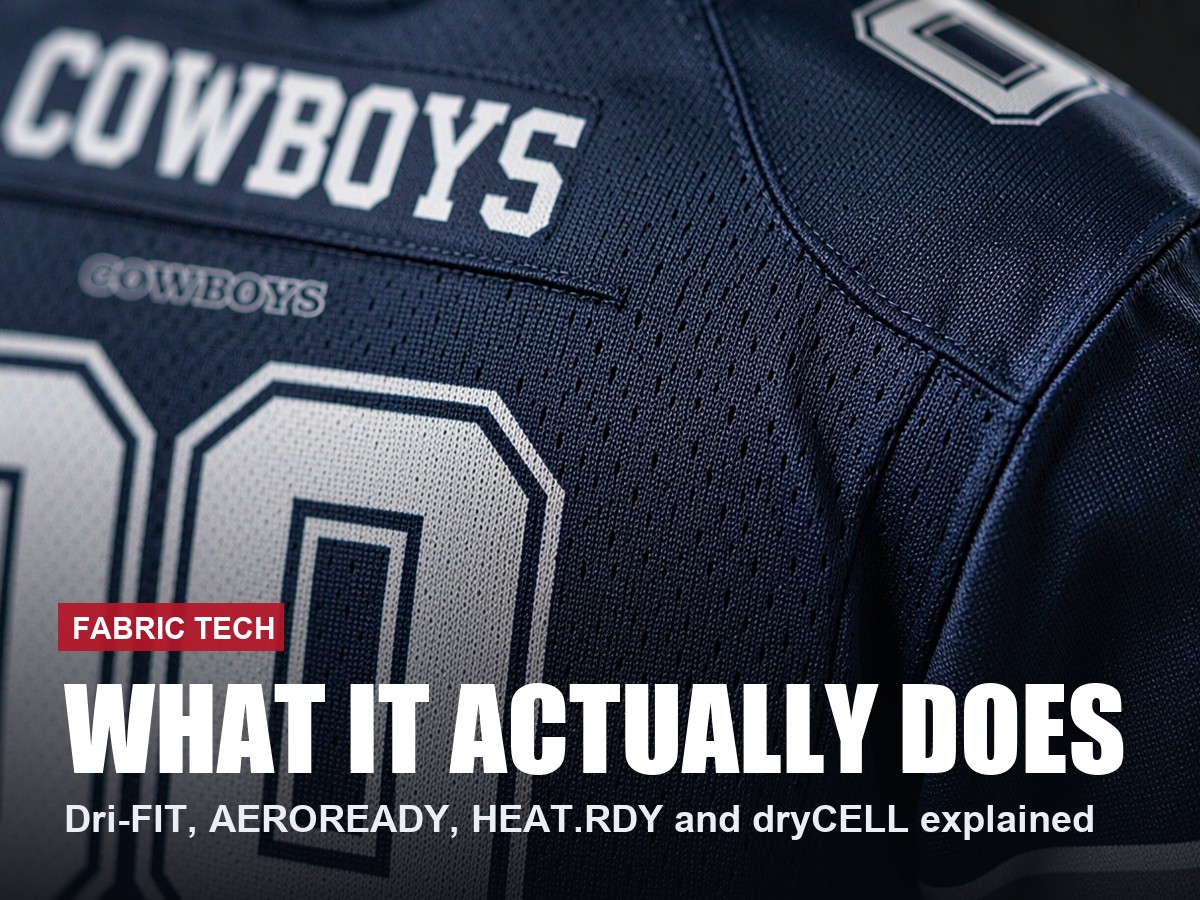
Jersey Fabric Technology Explained: What Each Name Actually Does
Nearly every jersey is polyester — the brand names describe how it is knitted and treated. What Dri-FIT, AEROREADY, Aero-FIT, HEAT.RDY and dryCELL actually do, and why one club sells two fabrics.
Quick answers
- Almost every jersey is polyester. The brand names describe how the fabric is knitted and treated, not what it is made of.
- Two things do the work: moving sweat away from the skin, and letting hot air escape through the structure.
- Dri-FIT and AEROREADY are the fan and training tier; Aero-FIT and HEAT.RDY are the match and player tier.
- The same club often sells both fabrics, and the difference is real — the match shirt is lighter and more ventilated.
- Mesh breathes best; double-knit is heavier and more durable. Most shirts mix the two by body zone.
- Recycled polyester performs identically to new polyester. For you the difference is environmental, not practical.
The short answer. Nearly every jersey is polyester, and the brand names describe how it is knitted and treated rather than what it is made of. Dri-FIT and AEROREADY are the fan and training tier; Aero-FIT and HEAT.RDY are the match and player tier. Recycled polyester performs identically to new polyester, so it is not a reason to pay more.
What every jersey fabric is doing
Strip away the brand names and almost every jersey on the market is doing the same two jobs. First, moving sweat off your skin and into the fabric so it evaporates instead of sitting against you. Second, letting hot air escape through the structure of the cloth rather than trapping it.
The names are how each brand describes the second half of that. Dri-FIT, AEROREADY and dryCELL are about moisture management. Aero-FIT, HEAT.RDY and CLIMACOOL+ are about ventilation — the shape of the knit, the placement of the mesh, the laser-cut holes.
- Nike fan / training — Dri-FIT — microfiber polyester that pushes sweat to the surface
- Nike match / player — Aero-FIT — open and closed knit zones that form air channels
- adidas fan / training — AEROREADY — absorbs moisture fast to keep the fabric dry
- adidas match / player — HEAT.RDY — light air-permeable yarn with body-mapped ventilation
- Puma — dryCELL — moisture wicking; ULTRAWEAVE on the player version
- Recycled content — Primegreen (adidas), Move to Zero (Nike), 95%+ recycled on Puma fan shirts
The brand decoder
Each brand runs two tiers, and it is worth knowing which is which before you compare prices.
| Brand | Fan / training fabric | Match / player fabric | How to tell them apart |
|---|---|---|---|
| Nike | Dri-FIT / Dri-FIT ADV | Aero-FIT | Match versus Stadium tier |
| adidas | AEROREADY | HEAT.RDY or CLIMACOOL+ | Player versus fan tier |
| Puma | dryCELL | ULTRAWEAVE | Player shirts are noticeably lighter |
| Under Armour | HeatGear (warm) / ColdGear (cold) | — | Two ranges split by temperature |
| Fanatics | Breakaway | — | The standard NHL fan fabric |
| Reebok | Speedwick | — | Moisture-wicking blend |
Swipe the table sideways to see every column →
Why the same club sells two different fabrics
This is the single most useful thing to understand when you are choosing between two shirts with the same badge on them. They are not the same product at different prices — they are built for different jobs.
The match or player version uses the lighter, more ventilated fabric: Nike calls it Aero-FIT, adidas calls it HEAT.RDY. It is designed for 90 minutes of running, with ventilation mapped to the heat zones of the body. The stadium or fan version uses a Dri-FIT or AEROREADY fabric that is more forgiving to wear all day, and costs less.
Both are official. If you want the shirt the players actually wear, take the match tier and expect a tighter cut. If you want a shirt you can wear to the pub for five years, the fan fabric is usually the better buy.
Construction: mesh, knit and jacquard
Two shirts can list the same fibre content and still feel completely different, because what changes is how the fabric is built.
| Construction | What it is | Why it is used | The trade-off |
|---|---|---|---|
| Mesh | Open weave with visible holes | Maximum airflow, lightest feel | Less durable, and shows through more |
| Double knit | Two layers knitted together | Smoother face, heavier, harder wearing | Less ventilation than mesh |
| Jacquard knit | Pattern woven into the fabric | Designs that are part of the cloth, not printed on | Heavier, and used on feature shirts |
| Sublimated panel | Dye bonded into the polyester | Unlimited colour, nothing to peel | Polyester only |
Swipe the table sideways to see every column →
Modern match shirts rarely use one construction across the whole garment. They are mapped: mesh where heat builds up (under the arms, down the sides, across the back), and a denser knit where the shirt needs to hold its shape or take a number. That is why the fabric can feel different in your hand depending on where you touch it.
Recycled polyester: what it actually changes
Most jerseys sold now contain recycled polyester — adidas calls the range Primegreen, Nike folds it into Move to Zero, and Puma’s fan shirts typically run at 95% or more recycled content. Nike’s current match fabric goes further and uses polyester chemically recycled from textile waste.
For the buyer, the honest answer is that it changes very little. Recycled polyester weighs the same, wicks the same and lasts the same as new polyester. If you are choosing between two shirts and one is recycled, the fabric is not the reason to pay more.
Fabric notes reviewed 22 September 2026 and checked against the technology descriptions and care labels for the Nike, adidas, Puma and Fanatics ranges we stock. Blends vary by model and season — the product page carries the exact breakdown for each shirt.
What does Dri-FIT actually do?
Is AEROREADY the same as Dri-FIT?
Why does the same club sell two different shirt fabrics?
Is mesh better than knit?
What is recycled polyester, and does it feel different?
What do Primegreen and Move to Zero mean?
Does a lighter shirt mean a worse shirt?
Why do some shirts have stretchy collars and cuffs?
How do I find out which fabric a specific shirt uses?
Is a more expensive shirt always a better fabric?
Related guides
- Jersey sizing guide — chest, S–5XL and the US to EU conversion
- Shipping and customs guide — what US, EU and UK buyers pay
- How jersey printing works — heat-pressed, stitched or sublimated
- Jersey care guide — how to wash, dry and store a shirt
- Jersey numbers explained — how each sport numbers its players
- Jersey gift guide — sizing, personalisation and Christmas dates
Choosing between a fan shirt and a match shirt?
Both are official, and both are built for different jobs. If you want the lightest fabric and the tightest cut, take the match tier. If you want a shirt to wear for years, the fan fabric is the better buy.
Shop jerseys