
How Jersey Printing Works: Names, Numbers and What You Get
Heat-pressed vinyl, sewn tackle twill and sublimation — how a name and number is actually applied, the standard sizes and placement, and how to spot a print that was never made properly.
Quick answers
- Three methods cover almost every shirt: heat-pressed vinyl, sewn tackle twill, and sublimation.
- Heat-pressing is the fast, light option and is what most replica and fan shirts use.
- Sewn tackle twill is the premium finish — heavier, more durable, and slower to make.
- Sublimation fuses the design into the fabric itself, so there is nothing to peel. It only works on polyester.
- Standard back numbers run 10 inches on adult shirts and 8 inches on youth sizes.
- We print to order, which adds a few days, and printed shirts cannot be exchanged for a different size.
The short answer. A name and number is applied one of three ways: heat-pressed vinyl, sewn tackle twill, or sublimation. Back numbers are normally 10 inches on adult shirts and 8 inches on youth sizes, sitting 2 to 3 inches below the collar seam. Printed shirts are made to order and cannot be exchanged for a different size.
The three ways a name and number goes on
Almost every printed shirt you can buy uses one of three methods. They differ in how the design attaches to the fabric, which is what decides how it looks, how it feels and how long it lasts.
- Heat-pressed vinyl — Cut to shape, bonded with heat and pressure — fast, light, the usual replica finish
- Sewn tackle twill — Layers of fabric cut and stitched on — the most durable finish, and the heaviest
- Sublimation — Dye fused into polyester — nothing to lift, unlimited colour, polyester only
- Back number size — 10 inches adult, 8 inches youth
- Letter height — 2–3 inches for an adult name
- Placement — Number 2–3 inches below the collar seam, name 1–2 inches above the number
| Method | How it works | Why people choose it | The trade-off |
|---|---|---|---|
| Heat-pressed vinyl | Cut vinyl bonded with heat | Fast, light, lower cost | Can lift or crack over years if washed hot |
| Sewn tackle twill | Fabric layers stitched on | Most durable, premium texture, ages well | Heavier, slower, costs more |
| Sublimation | Dye fused into the fabric | Nothing to peel, unlimited colours | Polyester only — no cotton |
Swipe the table sideways to see every column →
Heat-pressed vinyl is the method behind most replica and fan shirts. A pre-cut set is placed on the shirt and bonded under heat and pressure. It is quick, keeps the shirt light, and looks clean — the reason club and league replica ranges use it.
Sewn tackle twill is what people mean when they say a print looks professional. Layers of fabric are cut to the shape of each letter and number, then stitched onto the shirt. It survives heavy use, and the texture is unmistakable — but it adds weight and takes longer to make.
Sublimation skips the idea of applying anything at all. The ink is turned to gas with heat and bonds into polyester fibres, so the design becomes part of the shirt. There is nothing to lift, and no limit on colours — but it only works on polyester, not cotton.
What you get on a replica versus an authentic shirt
Replica shirts almost always use heat-applied vinyl or a transfer sheet: durable, inexpensive at scale, and light enough not to change how the shirt hangs. Match-spec and authentic shirts often use thinner, more flexible heat-sealed sets designed for perforated performance fabric, and on retro reissues you will find sewn-on twill or flock instead — heavier, and much harder to fake convincingly.
Number and name sizes, and where they sit
| Element | Standard size | Notes |
|---|---|---|
| Adult back number | 10 inches | Youth sizes use 8 inches |
| Sleeve number | About 4 inches | Where the design includes one |
| Name letters | 2–3 inches | Smaller on youth shirts |
| Number placement | 2–3 inches below the collar seam | Centred horizontally |
| Name placement | 1–2 inches above the number | Applied to a matching nameplate |
Swipe the table sideways to see every column →
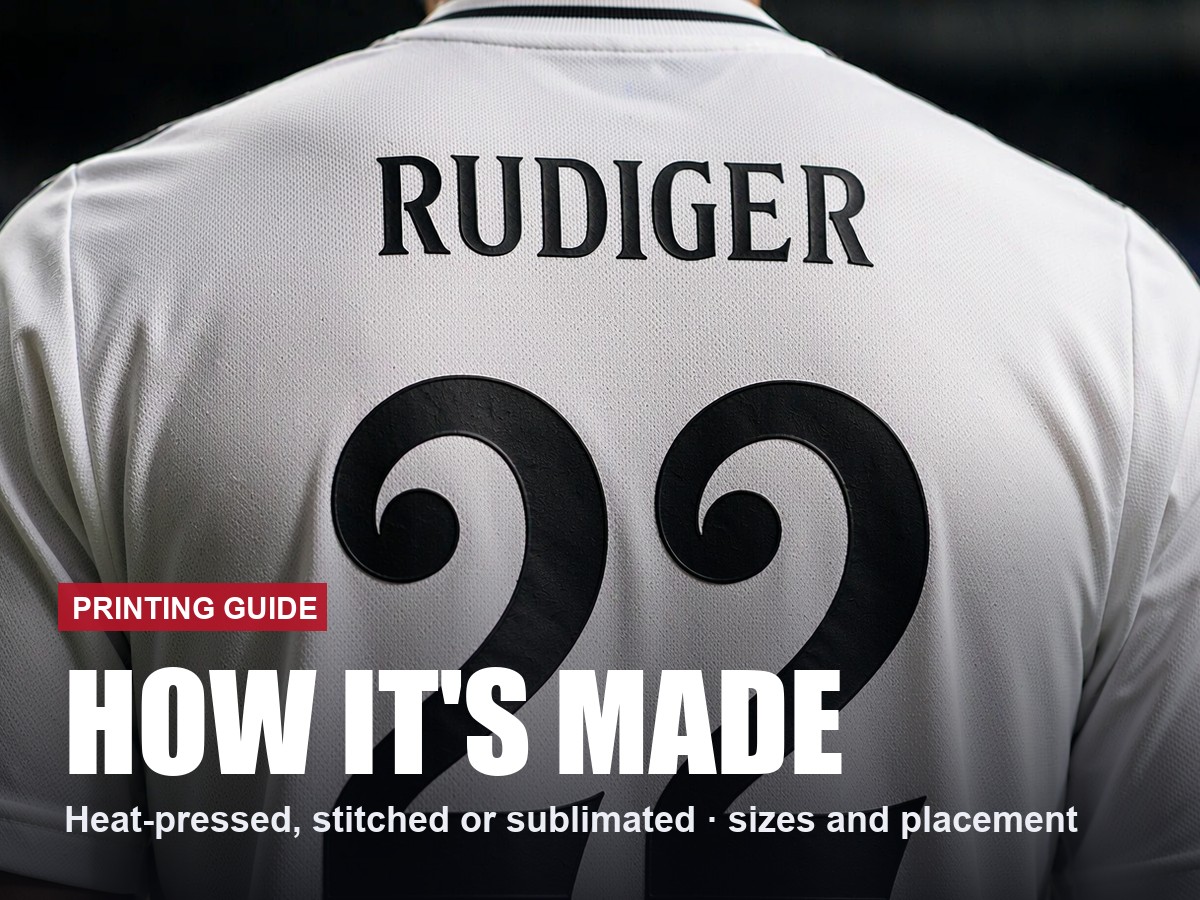
Placement is more standardised than most buyers expect, and it is worth knowing because a misaligned print is the giveaway that something was produced in a hurry. Numbers sit 2 to 3 inches below the collar seam and are centred across the back; the name sits on a matching nameplate 1 to 2 inches above the number.
Reading a nameplate: contrast and character limits
High contrast is the rule — white on a dark shirt, dark on a light one — so the name reads from the stands and from a photo. Font weight matters too: heavy strokes look right on a large back number and crowded on a small sleeve number.
The nameplate has a fixed physical width, which is why very long surnames get compressed to fit. If the name you are ordering is close to the limit, that is the one detail worth checking before you pay, because a squeezed name is hard to un-see once the shirt arrives.
Looking after a printed shirt
Heat is the enemy, not wear. Wash cool and inside out, keep the shirt out of a hot dryer, and never iron over the print — if you must iron, press the reverse of the fabric. A correctly applied set holds for seasons under those conditions.
Telling a genuine print from a fake
Four checks do most of the work: the weight of the strokes, the spacing between letters, the edges of the cut, and the period the font belongs to. Official sets use fixed kerning and clean cut lines, and the font acts as a date stamp — a current-season font on a ten-year-old shirt means the print was added later, if the shirt is genuine at all.
Genuine sets also feel supple. Cheap vinyl feels like plastic sheeting and lifts at the corners long before a properly pressed set would.
Printing standards reviewed 22 September 2026. Sizes and placement follow the conventions used across the NFL, NBA, MLB, NHL, NCAA and soccer ranges we stock; the print method varies by range and is listed on each product page.
How long does printing take?
What is the difference between heat-pressed and sewn numbers?
Will the print peel off?
What is sublimation printing?
What size are the numbers on a jersey?
Where does the name and number go on the back?
Is there a limit on how long a name can be?
Can I use accented letters or special characters?
Can I put a retired number on a shirt?
How can I tell whether a print is genuine?
Can a printed shirt be returned or exchanged?
Related guides
- Jersey sizing guide — chest, S–5XL and the US to EU conversion
- Shipping and customs guide — what US, EU and UK buyers pay
- Jersey care guide — how to wash, dry and store a shirt
- Jersey numbers explained — how each sport numbers its players
- Jersey gift guide — sizing, personalisation and Christmas dates
- Jersey fabric technology — what each name actually does
Adding a name and number?
Printed shirts are made to order — a few days longer to dispatch, and not exchangeable for a different size or design. Check the measurements and the spelling first, then order with confidence.
Shop jerseys