

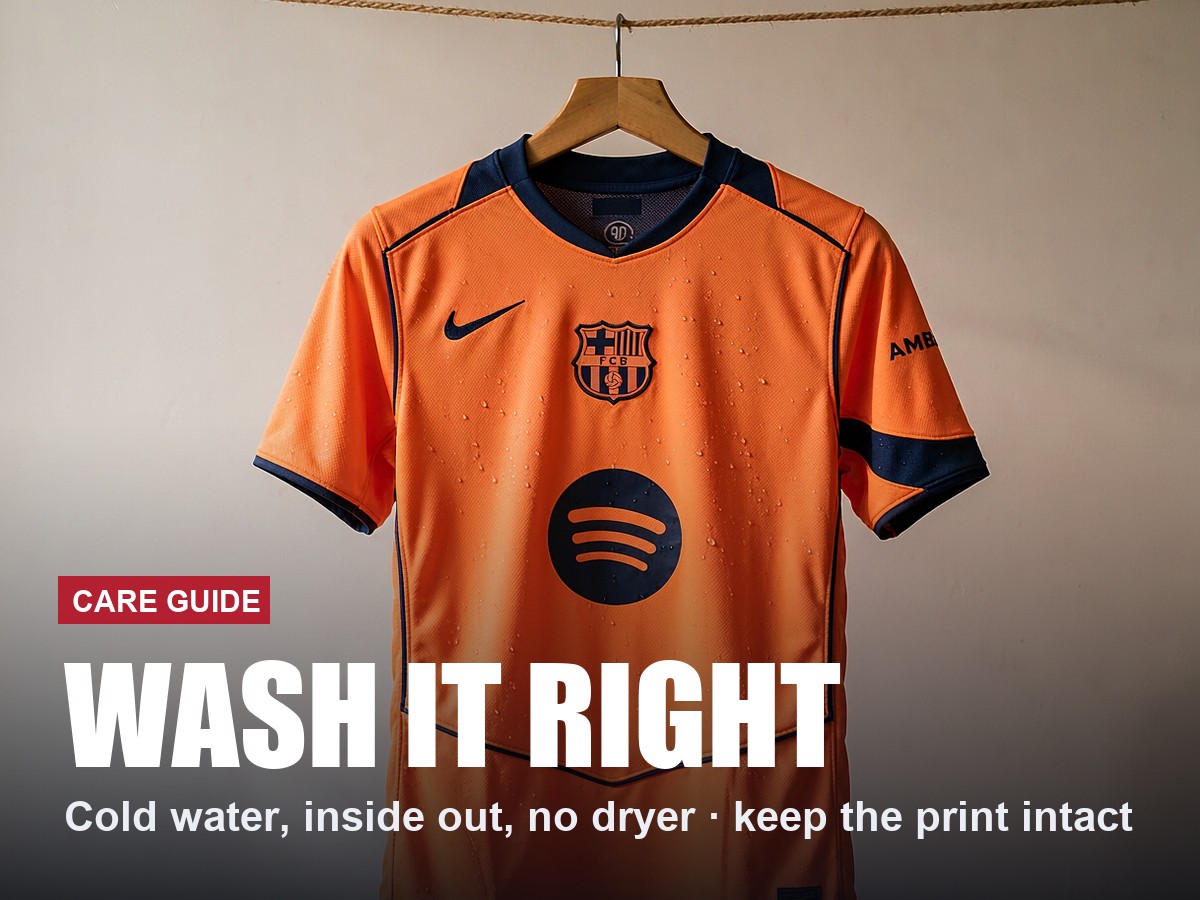
Jersey Care Guide: How to Wash, Dry and Store a Shirt Properly
Cold water, inside out, no fabric softener and no dryer. How to wash a jersey without cracking the print, and how much gentler a player-issue shirt needs to be treated than a replica.
Quick answers
- Cold water only — 30°C is the ceiling. Heat is what cracks prints and fades colour.
- Turn the shirt inside out before every wash so the machine rubs the plain fabric, not the badge.
- Never use fabric softener: it coats the fibres and blocks the wicking that makes the shirt breathable.
- Never tumble dry. Heat shrinks polyester and lifts heat-pressed names and numbers.
- Skip bleach entirely — chlorine reacts with antiperspirant residue and turns underarm marks orange.
- Player-issue shirts with heat-pressed crests need the gentlest handling; replica shirts with stitched badges are the toughest.
The short answer. Wash a jersey cold — 30°C at the most — inside out, with a mild liquid detergent, and never add fabric softener or bleach. Never tumble dry: heat shrinks polyester and lifts heat-pressed prints. Air dry in the shade, and steam out creases instead of ironing.
Why a jersey is not a t-shirt
Almost every shirt we sell is built from a technical polyester — Nike’s Dri-FIT, adidas’ AEROREADY or HEAT.RDY, or the equivalent from Puma. Polyester is durable and it dries fast, but it is heat-sensitive: it warps at temperatures where cotton would not notice.
The detail you are protecting is not the fabric, though. It is the print. Crests, sponsor logos, names and numbers are bonded to the shirt with heat or stitched on, and heat-applied detail is the part that fails first. Care for the print and the rest looks after itself.
- Wash temperature — Cold, or 30°C maximum
- Turn it — Inside out, every time
- Detergent — Mild liquid — powder leaves residue in the fibres
- Never use — Fabric softener, bleach, hot water
- Drying — Air dry in the shade — flat or on a wide hanger
- Ironing — Avoid — or inside out, lowest synthetic setting, never over prints
The short version: four rules
| Stage | Do this | Because |
|---|---|---|
| Wash | Cold or 30°C, inside out, mild liquid detergent | Hot water softens the adhesive behind names, numbers and crests |
| Protect | Use a mesh laundry bag, and wash with light similar colours | Zips, towels and jeans snag prints and pill the fabric |
| Dry | Air dry in the shade, flat or on a padded hanger | Heat shrinks polyester and lifts prints permanently |
| Store | Cool, dry, out of direct light — breathable, not plastic | Plastic traps moisture; sunlight fades colour over time |
Swipe the table sideways to see every column →
Washing, step by step
Turn the shirt inside out before it goes near the machine. That single habit does most of the work: the drum agitates the plain inside of the fabric instead of dragging across the badge and the numbers.
Wash cold, or 30°C at most, on a gentle cycle, with a mild liquid detergent. Powder detergents can leave gritty residue trapped in the fibres, and strong detergents with optical brighteners attack both the colour and the structure of the fabric.
Use a mesh laundry bag if you have one — it is the recommendation in manufacturers’ own care guidance — and wash the shirt with light, similar fabrics. Zips, towels, jeans and Velcro all create friction that pulls threads and dulls prints. Take the shirt out as soon as the cycle finishes: left wet in the drum, colours migrate and creases set into the print.
What to never put in the machine
Fabric softener. It feels like it is helping, but it leaves a water-repellent film on polyester fibres that seals the channels responsible for wicking sweat away from your skin. The shirt stops breathing and starts holding odour, and it builds up wash after wash.
Bleach, including colour-safe bleach. On a white shirt the chlorine reacts with antiperspirant residue and turns underarm marks orange — permanently. Use an oxygen-based stain remover instead.
Hot water. The most common cause of shrinkage, shape distortion and print lift, all at once.
Drying: where most damage actually happens
Washing starts the wear; drying finishes it. A tumble dryer heats the shirt enough to shrink polyester and soften the adhesive under printed names, numbers and crests — and once a print bubbles or lifts, nothing reverses it.
Air dry instead, in the shade. Direct sunlight fades colour, and colour is the whole point of a bright shirt. Lay it flat or hang it on a wide, padded hanger; wire hangers leave bumps in the shoulders. Do not wring or twist a wet shirt to speed it up — press the water out between towels instead. A wet shirt that has been twisted dries into a distorted shape that no amount of care fixes later.
Ironing, and the steam alternative
The honest answer is that a polyester jersey dried properly does not need ironing. If you do need to remove a crease, work inside out on the lowest synthetic setting, keep the iron moving, and put a thin cloth or towel between the iron and the fabric. Never press directly over a badge, number or name.
The better trick is steam. Hang the shirt in the bathroom while you shower and the creases relax out of the fibres in 10 to 15 minutes, with no risk to the print at all.
Care by shirt type
How much care a shirt needs depends on how the badge is attached, not on how much it cost.
| Shirt type | Badge | The right routine | Why it matters |
|---|---|---|---|
| Player issue / authentic | Heat-pressed crest | Hand wash preferred, cold, inside out, air dry | Most sensitive — heat and abrasion both lift the badge |
| Replica / fan shirt | Stitched or embroidered crest | Machine wash cold, gentle cycle, inside out | Most forgiving — just do not scrub the badge |
| Retro and vintage | Older flock, screen print or stitched badge | Hand wash only, cool, dry flat | Old prints and badges are not built for machine agitation |
Swipe the table sideways to see every column →
Heat-pressed crests — the type used on player-issue and authentic shirts — have three enemies: heat, abrasion and long soaking. Cold water, inside out, gentle or hand wash and air drying avoid all three. Embroidered crests on replica shirts are stitched into the fabric and survive years of normal washing; the only thing to avoid is scrubbing directly on the badge.
Storing shirts you do not wear
Keep them cool, dry and out of direct light. Hang regular shirts on wide padded hangers or fold them loosely — cramming them into a tight drawer sets permanent creases. Skip plastic bags for anything long-term, because they trap moisture.
For collectable and retro shirts the rules tighten: acid-free tissue or a garment bag, folded flat rather than hung so the shoulders do not stretch, and UV-protective glass if you frame one.
Care guidance reviewed 22 September 2026 and checked against manufacturer instructions for the Nike, adidas and Puma ranges we stock. If the care label sewn into your shirt disagrees with anything here, follow the label — it is written for that specific fabric.
What temperature should I wash a jersey at?
Can I put a jersey in the tumble dryer?
Why can I not use fabric softener?
Should I turn a jersey inside out before washing?
How do I get yellow underarm marks out of a white jersey?
Can I iron a jersey?
How often should I wash a jersey?
Does it matter which jersey version I have?
How should I store a jersey I do not wear?
What should I do if a printed number starts to lift?
Related guides
- Jersey sizing guide — chest, S–5XL and the US to EU conversion
- Shipping and customs guide — what US, EU and UK buyers pay
- How jersey printing works — heat-pressed, stitched or sublimated
- Jersey numbers explained — how each sport numbers its players
- Jersey gift guide — sizing, personalisation and Christmas dates
- Jersey fabric technology — what each name actually does
Buying a shirt to keep?
Cold water, inside out, no softener, no dryer. Four habits keep a printed shirt looking right for years — and if you are ordering custom printing, they matter even more, because a printed shirt cannot be exchanged.
Shop jerseys